Before the sunrise, the question paper of one of India’s largest engineering entrance examinations was already on sale. In Kanpur and Lucknow, question papers were being offered for ₹6 lakh each. In parallel, nearly 12 lakh young aspirants had reached more than 1,600 examination centres across the country. Many of them were already seated, carrying years of preparation and their families’ expectations with them. Soon, the Uttar Pradesh Special Task Force obtained the paper leak and alerted the Central Board of Secondary Education. The CBSE compared it with the original paper and confirmed that it matched. The examination scheduled for 9:30 am was delayed across the country. A fresh set of questions was hurriedly brought into use. Thousands of students faced confusion, travel problems, and clashes with other entrance examinations. Does this sound like a scandal unfolding in 2026? It is not. This happened on 1st May 2011, during the UPA government. The examination was the All India Engineering Entrance Examination, or AIEEE. Kapil Sibal was the Union Minister for Human Resource Development. A committee was constituted,d police investigations began, and the examination was completed after a nationwide delay. But no Union Education (then HRD)Minister resigned. Kapil Sibal continued as HRD Minister after the leak.
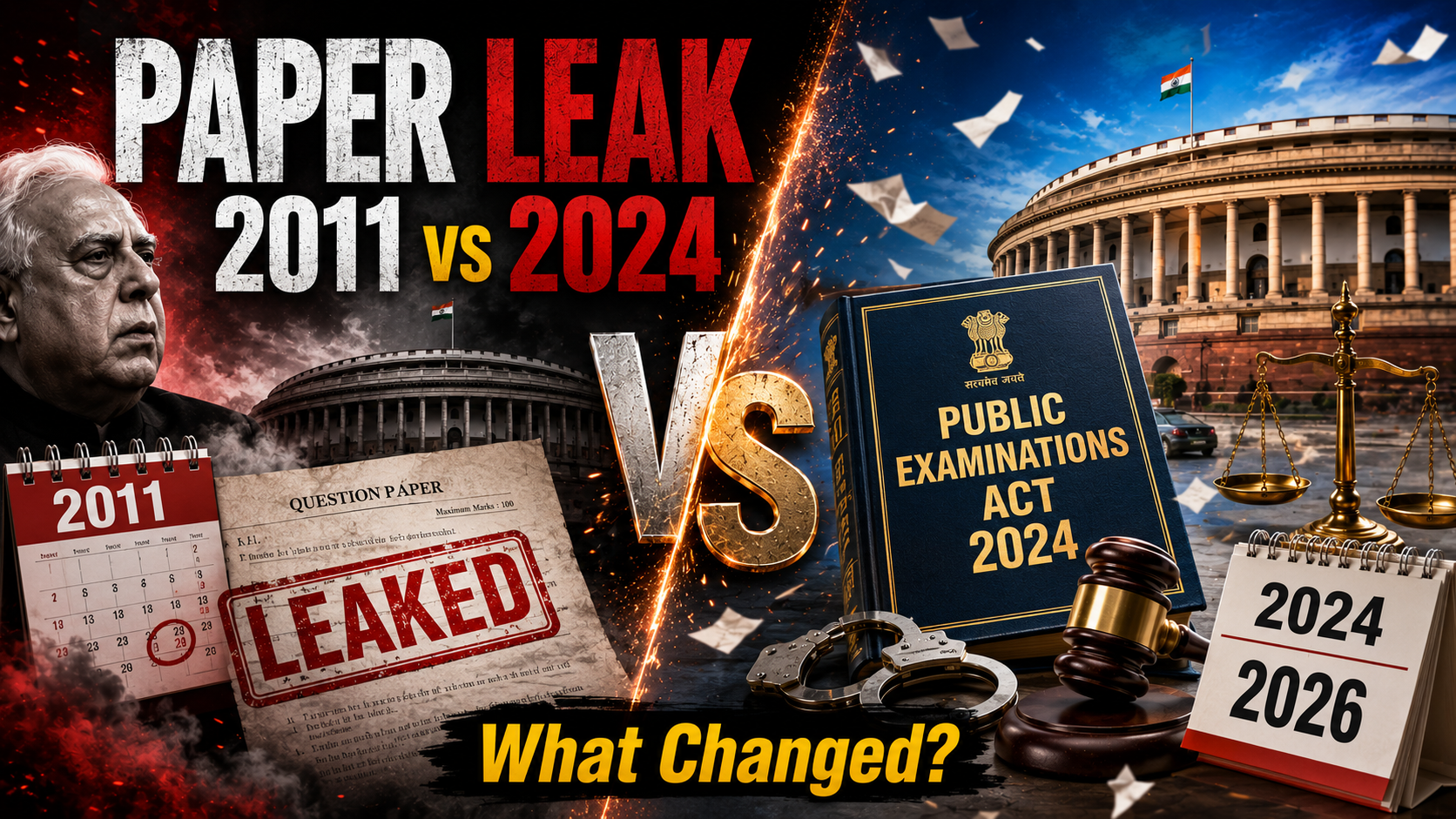
Why must 2011 be remembered? Revisiting this history is not an attempt to excuse any present-day examination failure. Every paper leak is an attack on merit. It punishes honest students, rewards criminal networks, and destroys confidence in public institutions. Every such case deserves investigation, prosecution, and accountability. But history becomes especially important when those questioning the government today behave as though examination leaks were invented after 2014, and as though previous governments had maintained a spotless record. The Opposition has repeatedly demanded the resignation of Dharmendra Pradhan over the NEET paper leak. The moral standard now being invoked was not even under consideration in 2011. There was no comparable national campaign declaring that the government had lost its moral right to remain in office. Those presenting themselves today as guardians of examination integrity must first explain why the same political principle was absent when they were in power.
For decades, a paper leak was not legally treated as a paper leak
India was conducting examinations through the UPSC, SSC, Railway Recruitment Boards, IBPS, CBSE and, subsequently, the National Testing Agency. These examinations determined access to engineering colleges, medical colleges, universities,es and lakhs of government jobs. Yet, until the enactment of The Public Examinations (Prevention of Unfair Means) Act 2024, India did not have a dedicated Central penal law specifically dealing with unfair means in public examinations conducted by the Central Government and its agencies. Some states had their own anti-cheating legislation, and general criminal laws were certainly available. But for national examinations, investigators had to break a paper-leak operation into pieces and fit those pieces into provisions written for entirely different crimes.
The old legal patchwork
Before the 2024 Act, police generally relied upon combinations of provisions such as:
These laws could punish individual acts associated with a leak. But none of them comprehensively addressed the complete paper-leak enterprise, and this produced several structural gaps and legal complications. For example, to establish criminal breach of trust, the prosecution had to prove that the accused had been legally entrusted with the confidential material. This might cover an official custodian, employee,ee or authorised person, but it was far harder to apply to a broker or middleman who received a photograph of the question paper and forwarded it later.
Similarly, Cheating required proof of deception and dishonest inducement. The mere fact that a confidential paper had escaped custody did not automatically satisfy every ingredient of cheating.
The Information Technology Act helped when servers, digital credentials, or fake online portals were involved. It was of limited assistance when a physical paper was removed from a printing press or distribution centre.
The Prevention of Corruption Act applied where public servants and illegal gratification were involved. It could not, by itself, address a leak organised entirely through a private printing vendor, outsourced service provider, coaching network,k or group of brokers.
Even the classification of the case could depend upon the particular sections invoked. Questions of bail, cognizability, compounding,ng and the rank of the investigating officer varied with the legal route adopted. The result was a system that could often catch a messenger, a candidate, or a small broker, while struggling to reach the organisers, financiers, and institutions behind the operation.
What did the 2024 Act change?
The Public Examinations (Prevention of Unfair Means) Act, 2024, changed the starting point. Instead of asking which traditional offence a paper leak resembled, Parliament defined the prohibited conduct itself.
The Act expressly covers:
It also recognises that paper leaks are frequently organised commercial crimes rather than isolated acts of cheating. For an ordinary offence under the Act, the original framework provides imprisonment of three to five years and a fine of up to ₹10 lakh. Organised examination crime carries imprisonment of five to ten years and a minimum fine of ₹1 crore. Where an institution is involved, its property may be attached and forfeited, and the proportionate cost of conducting the examination may be recovered. Service providers can be fined up to ₹1 crore, made to bear the examination cost, and debarred from examination work for four years. Directors and senior management can face personal criminal liability where consent or connivance is established. Failure by a service provider to report an offence is itself punishable.
Most importantly, all offences under the Act are cognizable, non-bailable, and non-compoundable. Investigation must be conducted by an officer not below the rank of Deputy Superintendent of Police (DSP) or Assistant Commissioner of Police (ACP), and the Central Government may refer a case to a Central Investigating Agency. The law does not erase the existing criminal framework. Section 15 of the said Act is in addition to other laws. Depending on the facts, the Bharatiya Nyaya Sanhita, Information Technology Act, Prevention of Corruption Act, and relevant state laws can continue to operate alongside it.
What does the 2026 Amendment Bill propose?
The 2024 Act created the dedicated offence. The Public Examinations (Prevention of Unfair Means) Amendment Bill, 2026 seeks to make enforcement faster and punishment substantially harsher.
The Bill proposes:
These provisions are proposals contained in the 2026 Amendment Bill. They will alter the law only after the Bill completes the parliamentary process and comes into force.
The real test is the intention of the Government
A paper leak is normally carried out by a criminal network like an insider, printer, vendor, broker, coaching operator, technical intermediary, or corrupt official. A Union Minister may have no personal knowledge of, participation in, or connection with the criminal act. Criminal responsibility must always be established through evidence. It cannot be presumed merely from political office. Political accountability is a separate question. But even there, the most meaningful test is not who can shout the loudest after a leak. The real test is what the government does to prevent repetition, investigate the network, and close the legal gaps that allowed organisers to escape.
Does the government deny that the problem exists? Does it treat every incident as an isolated embarrassment? Or does it create a permanent legal architecture capable of punishing not only the person carrying the paper, but also the service provider, company management, institution, and organised network behind the crime?
For decades, governments of different parties faced examination leaks. General criminal provisions were invoked, committees were constituted,d and examinations were rescheduled. Yet no central government has enacted a comprehensive law specifically protecting national public examinations. The Narendra Modi Government did so in 2024 by defining paper leaks as a distinct category of public-examination crime, making the offences cognizable and non-bailable, recognising organised networks, imposing institutional liability, and permitting property forfeiture. The 2026 Amendment Bill now seeks to go further through higher punishment, time-bound investigation, and fast-track trial. No law can guarantee that a criminal will never attempt a paper leak. But legislation reveals whether a government is prepared to confront the crime structurally. That is where intent becomes visible.
The history of AIEEE 2011 shows how a leak was once handled within a framework of general offences, administrative improvisation, and unresolved questions. The 2024 Act and the 2026 Amendment Bill demonstrate a fundamentally different approach: define the crime, punish the network, hold institutions liable, and ensure that investigation and trial do not continue indefinitely.


